History
According to Homer, the first known inhabitants of northern Evritania -Karpenisi- were the Dolopes, who took part in the campaign against Troy around 1100 BC. The ancient capital of the area was Oihalia, situated close to the city of Karpenisi. Ancient Evritanians especially honored Diana, the goddess of hunting and Ulysses for his ability to be cunning and inventive.
There are two possible explanations for the origin of the name "Evritania". The first is that is formed from the Greek word "ev" for "well" and the verb "hreo", for "flow" so that altogether the word "Evritania" means the place where there is plenty of fresh and "well flown" water. The second explanation for the names origins, comes from the verb "evrio", meaning "stretching the cord of the bow", hence the name of the first king of the area, Evritos, who was an excellent archer.
In later Roman and Byzantine years, the area became better known, especially after the battle between the Roman and the Aetolian Commonwealth (Greek) armies, in the location of "Kokalia", which ended in favour of the former. During the Byzantine times, the people of Evritania had the rare privileges of self-government and tax exemption. For this reason the northern part of the district was also called "Agrafa" (unwritten), because the residents were not listed in the Imperial tax registers
During the Turkish occupation of Greece, this area remained relatively free, especially the very remote areas in the mountains. For this reason, the population of the villages grew. During the 18th century a famous school was created here by Evgenios Yannoulis the Aetolian, a school which had a great contribution in awakening the ethnic consciousness of the nation. The Turks and Albanians raid the territory many times. However one of the turning points, at the historic site of Kefalovrisso, on the night of August 8, 1823, was when General Markos Botsaris was killed by the Turkish army sent by the Sultan to stop the Greek Rebellion. The Greek troops won the battle and, although the great shock from the death of the hero at first, the soldiers were to fight more bravely from then after.
During the Second World War, when Hitler's Nazis and Mussolini's fascists were occupying the whole country, the "Government" was established in the village of Viniani during the Spring of 1944 and it proclaimed elections for a National Counsel. This Committee was convoked at Korischades, in the school building in 1944 with representatives from all over the country, and made substantial decisions about the Resistance war. These mountains became the stronghold of the Greek freedom fighters (Hellenic Liberation Army - EL.A.S.) against the German occupation during World War II. In the path of history, Karpenisi faced many destruction, the latest being its burning by the German army in the 1940’s.
Monasteries that are built on high rocks can be visited by anyone. The monks are ready to offer their hospitality and blessings from God to the visitors. The best known are the monasteries of Prousiotisa and Tatarna. They are preserved as part of Greece’s national, religious, and folklore inheritance.
NATURE:According to 1991 UNESCO research, Euritania is considered one of top areas of the world in environmental cleanliness and the cleanest area in Europe. It represents the "basis" for research measurement as it is considered to have a zero pollution rate.
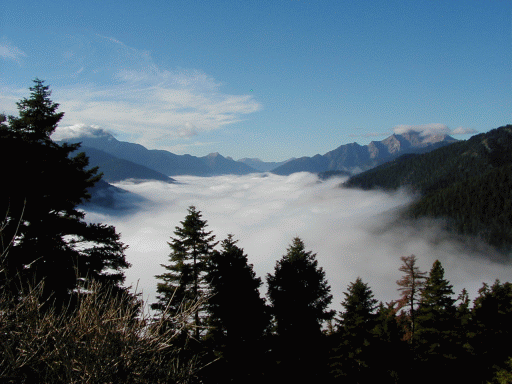
The County has a Mediterranean climate, mainland mountainous with frequent rain, mild winters and cool summers. It is a clearly mountainous area, most of which is at an altitude of over 1000 m., which offers great aquatic richness and vast forest cover. One large piece of the area of Euritania is spread over the main body of Pindos. It is surrounded by the mountains: Agrafa, Timphristo, Oxia, Panaitoliko, Helidona and Kalliakouda. It is traversed by the rivers: Karpenissioti, Tavropo (Megdova), Agrafioti, Krikelopotamo, Trikerioti and Acheloos. The aquatic wealth has been supplemented since 1965, by the Kremaston artificial lake, which is also Europe's largest earth dam. About half of the County's area consists of forests. Fir trees dominate the highest mountain peaks. Lower down, there are oak forests, while below 1000 m. Mediterranean vegetation such as arbutus, olive trees etc. predominates. Mountain valleys, shaped by the rivers permit the creation of small, cultivatable areas. The fauna of the area is also rich. Large mammals such as bears, roe deer, wild boars, wolves and other, smaller animals find refuge here. Different kinds of birds of prey and the Episcopy lake wild trout complete the area's biodiversity.
Copyright © 2002-Present. All rights reserved.
Photos on this site are Copyrighted. Copying and use of these without expressed written permission from this site's owners is strictly prohibited.